PROPERTY OWNERS, NOT DEVELOPERS, PAYING FOR NEW CITY DRAINAGE PROGRAM SO FAR Although it’s been collecting drainage fees from property owners for a year, the city of Houston still has yet to begin collecting a parallel funding source for its new ReBuild Houston infrastructure program. A deputy director of public works admitted in a meeting last week that a promised developer impact fee — one of 4 sources of funding established for street and drainage improvements — has not yet been put in place. Fees from developers are meant to pay for measures that would offset the effects of future development on flooding and street capacity, according to a city website describing the program. [The Leader]

Sign up for the Newsletter


Tag: Utilities
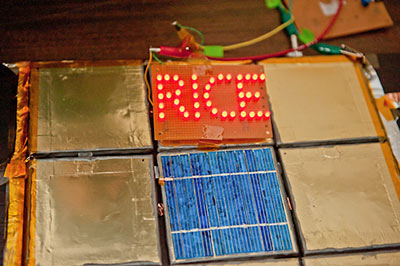
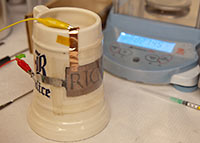 A team of researchers at Rice University have created a lithium-ion battery that can be spray-painted on to any surface. The first surface they tested the 5-layer power-storing combo on was a set of bathroom tiles. Since then, flexible, glass, and steel surfaces — as well as a beer stein emblazoned with the Rice insignia — have been tested and used successfully to store small amounts of electricity. Graduate student and lead author of the team’s report Neelam Singh imagines buildings sheathed with battery-sprayed ceramic tiles that are then covered by solar cells, integrating energy gathering and storage functions on a structure’s exterior skin.

IT’LL TAKE A LITTLE WHILE TO ASSEMBLE THAT NEW IKEA ROOFTOP FURNITURE 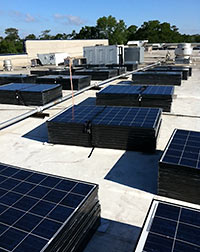 All the pieces are there, but now here comes the hard part. A scene familiar to many IKEA customers is now taking place on a large scale on top of the Houston IKEA store’s roof, where workers from contractor REC Solar are assembling flat-packed stacks of 3,962 solar panels into a 116,400-sq.-ft. PV array. The panels arrived on site at the end of last year, but construction won’t be complete until sometime this summer. When it’s done, the company says, the installation will generate enough energy to power 113 homes — or a larger number of in-store room displays. [Swamplot inbox; previously on Swamplot] Photo: IKEA Houston

COMMENT OF THE DAY: IN DEFENSE OF IKEA’S STARTER SOLAR PANELS “1) The electricity amount is irrelevant. What better option is there for using their rooftop real estate? 2) All energy projects are subsidized. The main differences with solar is that homes and businesses can access energy subsidies generally reserved for much larger corporations who work further upstream. 3) Assuming an install cost of $2.50/W, an effective generation rate of $0.08/kwh, the Fed ITC of 30%, and depreciation, the project has 12 year payback on a 25 year warranty. It’s not great investment, but its a secure, has markting benefits, and increases the resale value of their building. Also, I imagine the recession has curtailed IKEA expansion, which implies IKEA is running out of depreciable assets. 4) Most state and local incentives are giant wastes of money, but Houston has none. In fact, it is the largest US city without a net-metering policy, and as such you can’t eliminate your electric bill with 100% on-site power generation in Houston anyway.” [SolarWonk, commenting on Houston IKEA Going Solar]
Plumbing the depths of institutional history for its 100th anniversary, the university shines a spotlight on the 2.5 miles of underground tunnels lurking below campus.

HOUSTON IKEA GOING SOLAR  Houston’s 300,000-sq.-ft. IKEA store on the Katy Fwy. near Antoine — along with 8 other southern-state locations and a distribution center — will soon be covered with rooftop solar panels. The furniture company’s U.S. solar program began late last year. Contractor REC Solar will install 3,962 PV panels measuring a total of approximately 116,400 sq. ft., which IKEA will own and operate, on top of the Houston store by next summer. A company press release estimates the Houston panels will produce 931 kW, for a projected annual electricity output of 1,317,500 kWH per year. [BusinessWire] Photo of panels installed earlier this year in West Sacramento: IKEA

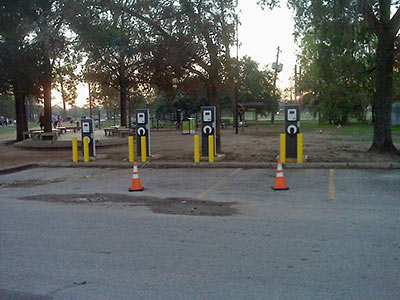
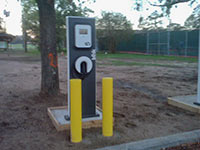 A reader who happened upon an outing of Blink stations at Memorial Park sends in this photo evidence that the commercial electric-vehicle chargers are multiplying. Two Blink stations at the nearby Houston Arboretum had been installed by the September 8th rollout of a city-wide drive-electric program. A total of 200 Blink-brand stations are being installed in the Houston area.
- ECOtality Announces the Expansion of The EV Project into Houston [Ecotality]
- Previously on Swamplot: More Jolts from Buffalo Grille Coffee, Houston EV Incentives: Free Jolt for Your Volt, Toll Relief for Your Leaf, Wired To Drive: Where Houston’s New Electric Vehicle Charging Stations Will Go
Photo: Swamplot inbox

MORE JOLTS FROM BUFFALO GRILLE COFFEE Now in the H-E-B Buffalo Market parking lot at Buffalo Speedway and Bissonnet, on the site of what used to be the Buffalo Grille: the first in a network of eVgo electric vehicle charging stations to be planted in parking lots around the city. The plug-in spots are right near what used to be the coffee serving area, notes Chronicle energy reporter Tom Fowler. Opening in the next couple of weeks: stations near NRG’s headquarters at the Shops at Houston Center downtown, and in front of 2 Walgreens: at 19710 Holzwarth St. and 8942 W. Sam Houston Pkwy. North. 25 of the Houston-area stations, featuring both 240-volt and the faster 480-volt chargers, are scheduled to open by the end of the year. [Fuel Fix; previously on Swamplot]
LOWERING EXPECTATIONS ON LAKE CONROE  Once Houston starts drawing water from the Montgomery County reservoir to stabilize levels in Lake Houston — as it is expected to do, for the first time in 23 years, as early as this Tuesday — the water level on Lake Conroe will likely drop between 3 and 4 inches per week. That’s on top of the typical rate of evaporation from the lake during the hot summer months — also about 3 or 4 inches per week. On Friday, the San Jacinto River Authority reported Lake Conroe was already 4 ft. below its normal levels — only a foot above its lowest level ever, during the drought of 1988. [Click2Houston] Photo: San Jacinto River Authority

SPURRING A TOILET REVOLUTION What the world needs now, according to the Bill and Melinda Gates Foundation: better places to poop. This year, the foundation will spend $3 million to fund 8 university teams working to reinvent the toilet. New off-sewer-system toilets for the 21st century would save lives around the world and “turn crap into valuable resources.” And who knows? Backwards thinking like that might end up making it cheaper to build more of our beloved way-out burbs around here too. [Gates Foundation] Video: Bill and Melinda Gates Foundation

City workers were on the job late yesterday repairing what appears to have been a broken water main on Kipling St. just east of Dunlavy in Mandell Place. The crews dug out the driveway and installed new pipe only 2 days after Swamplot’s report on neighborhood pumping operations (and a Houston Press follow-on) — but more than 2 weeks after the leak was originally reported to the city. No word yet on whether repairs have been completed.
- Previously on Swamplot: Pumping the Streets: Drought Brings Mandell Place Residents Free Water
Photo: Candace Garcia

PEDEN WATER MYSTERY What’s with the water flow on Peden St. just east of Montrose Blvd.? An “avid” Swamplot reader writes: “A cluster of my neighbors . . . have received CoH water bills for the past 4 months that are much higher than average. As you know, the City helpfully advises we ‘check for leaks.’ No leaks. Check. I’ve tested the water meter with controlled withdrawals. The meter itself seems fine. Check. As best as we know from our individual habits, none of us have significantly changed our water use patterns, even in this hot, hot summer. Much of my flora is dead or dying. Check again. Can you or any of your readers suggest any steps we might take to find out what’s going on here, fight the Water Dept and these absurd bills? I thought of hiring a civil engineer, but my Google search didn’t find anyone that seemed to fit the ‘water’ bill. Can you help?” [Swamplot inbox]
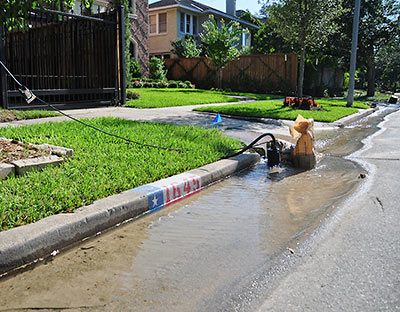
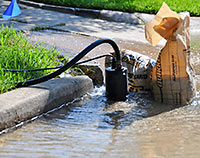 What to do when the city can’t get around to fixing that leak on your street? An enterprising resident of Kipling St. near Dunlavy bought an $80 pump at Southland Hardware and connected it to a hose, allowing neighbors to take turns watering their lawns with the water, which has been running for about 2 weeks. “I hope the cost of the electricity is less than the water cost savings,” he tells Swamplot photographer Candace Garcia. Garcia herself called 311 about the leak more than a week ago, and says others who have reported it say they’ve been told by city officials that the heat and drought has caused more than 400 water leaks around the city, and that the biggest leaks are being tackled first. As of last night, a second pump has begun operating up the street.
Photos: Candace Garcia


Whatever your ethnicity, it’s probably not too far off from that of Julie, the Sitepal avatar some fun folks at Rebuild Houston have been using to narrate a series of videos demonstrating how to look up and recalculate the new drainage fee on your property using the city’s Drainage Utility Charge Viewer. Julie’s kinda like you — only maybe she moves and talks a little more stiltingly, and she probably wears more makeup. She’s probably also a little less concerned about the resulting monthly costs, or the imperviousness of the whole thing. Still, Julie’s a trooper: She appears to be standing in the middle of Buffalo Bayou, getting her own feet wet as she processes the script into remarkably natural-sounding speech, blinks occasionally, and convincingly wiggles her lips to the words.
COMMENT OF THE DAY: SHOW US YOUR PIPES! “Thats not stupid to show that. Thats’ not the inside of a sewer line, but it is the tunnel the plumbers have to dig to install the new sewer lines. A lot of old slab houses have broken sewer lines and you might never know. That work costs some serious jack!!” [Freddie J Jones, commenting on Houston Home Listing Photos of the Day: Fresh Sewage, Pipes]