COMMENT OF THE DAY: HOUSTON REAL ESTATE PROBLEMS, WITH OR WITHOUT CHEAP OIL  “The Houston market had a few easily identifiable problems even before the drop in oil prices.
1) Older homeowners with paid off or mostly paid off homes are asking unrealistically high prices for fixer uppers or tear downs. That’s slowing down new home purchases and new builds. That was a problem at $100 oil. Well priced homes moved and unrealistically high priced homes sat. People wanting $300K for a total fixer upper inside Beltway 8 or $400K for a lot near the 610 loop are just completely slowing down the revitalization process as those houses/lots sit for months on end while everyone thinks the sky is falling.
2) Near loop new construction is priced exclusively for people making $200K and up. A family of two earners making $50K (teachers, cops, firefighters, non O&G professionals) can only afford to live out west in the burbs, but many are choosing to rent rather than go west. There’s no attempt at affordable housing inside the beltway. When oil goes down, the engineers stop buying in Houston. The aforementioned buyers would be happy with smaller houses they could afford to get into but the developers are chasing the biggest gains possible on each new build.
The real estate market will ultimately be fine for people who didn’t overpay but it would be nice to see changes that reflect reality now that oil is not at $100.” [Houstonian, commenting on Tanking Oil Prices Place Houston Second on Fitch’s Overvalued Housing Market List] Illustration: Lulu
“The Houston market had a few easily identifiable problems even before the drop in oil prices.
1) Older homeowners with paid off or mostly paid off homes are asking unrealistically high prices for fixer uppers or tear downs. That’s slowing down new home purchases and new builds. That was a problem at $100 oil. Well priced homes moved and unrealistically high priced homes sat. People wanting $300K for a total fixer upper inside Beltway 8 or $400K for a lot near the 610 loop are just completely slowing down the revitalization process as those houses/lots sit for months on end while everyone thinks the sky is falling.
2) Near loop new construction is priced exclusively for people making $200K and up. A family of two earners making $50K (teachers, cops, firefighters, non O&G professionals) can only afford to live out west in the burbs, but many are choosing to rent rather than go west. There’s no attempt at affordable housing inside the beltway. When oil goes down, the engineers stop buying in Houston. The aforementioned buyers would be happy with smaller houses they could afford to get into but the developers are chasing the biggest gains possible on each new build.
The real estate market will ultimately be fine for people who didn’t overpay but it would be nice to see changes that reflect reality now that oil is not at $100.” [Houstonian, commenting on Tanking Oil Prices Place Houston Second on Fitch’s Overvalued Housing Market List] Illustration: Lulu

Sign up for the Newsletter


Tag: Comments

COMMENT OF THE DAY: WHY IS ANYONE LIVING THAT CLOSE TO A REFINERY?  “Tax policy should probably discourage residential habitation in neighborhoods near the Houston Ship Channel and encourage people to move away from them. As such, giving existing residents or residential property owners a tax cut in order to reward them for residing there or maintaining and leasing housing to other people would be extraordinarily counterproductive and stupid.
Manchester in particular is a neighborhood where the City or State government should seriously consider its options with respect to eminent domain. There’s nothing quite like it anywhere else in the region. Even the furthest north residential bits and pieces of Pasadena are better isolated from refinery activities and more integrated into their city than is Manchester.” [TheNiche, commenting on Baytown Buc-ee’s Is Here; Goodbye Mission Burrito, Hello Ãœberrito Mexican Grill] Illustration: Lulu
“Tax policy should probably discourage residential habitation in neighborhoods near the Houston Ship Channel and encourage people to move away from them. As such, giving existing residents or residential property owners a tax cut in order to reward them for residing there or maintaining and leasing housing to other people would be extraordinarily counterproductive and stupid.
Manchester in particular is a neighborhood where the City or State government should seriously consider its options with respect to eminent domain. There’s nothing quite like it anywhere else in the region. Even the furthest north residential bits and pieces of Pasadena are better isolated from refinery activities and more integrated into their city than is Manchester.” [TheNiche, commenting on Baytown Buc-ee’s Is Here; Goodbye Mission Burrito, Hello Ãœberrito Mexican Grill] Illustration: Lulu

COMMENT OF THE DAY: BOSTON. IT’S WORTH IT TOO.  “I live in Boston which is pretty much the anti-Houston, moving there as an adult fleeing some of the things Blue Dog celebrates. Born and raised in sprawling Omaha, Nebraska, with its struggling downtown and leapfrogging subdivisions, I came east seeking the density, the option of subways and streetcars and walking because of the relative proximity of destinations, the historic architecture of row houses and institutions, the amenities of a major gateway city with an urban vibe. You’d hate Boston, the high cost of living, the terrible traffic on our chaotic layout of colliding streets, the lack of space, and the cold winters. I don’t like those things either, but I’ve decided to live with them because of the things I do like. You’ve made your choice too, and you intelligently don’t deny that you live in flat, sprawling, hot-humid, ten-lane-wide highway beribboned mass of strip mall scattered anonymity because you like it. And no snobby eastern elitist transplant so blinkered, he can’t appreciate the collective expression of American freedom that is Post Oak or The Woodlands or Sugarland or cul-de-sac-paradise-of-your-choice will . . . convince you otherwise. Midtown does seem to me kind of nice though :-)” [Robert H, commenting on Comment of the Day: The Real Houston Is Outside Those Tiny Urban Islands] Illustration: Lulu

COMMENT OF THE DAY: ENJOY THE RIDE  “Houston: the wonder city that showed the country how laissez-faire economics, conservative values, and lax planning lead to growth and prosperity.
It turns out Houston was just benefiting from another bubble and a siphoning of wealth from the rest of the country via higher gasoline prices.
The shale boom was supposedly proof that peak oil was dead and we can keep building car-dependent cities. Houston was riding into the future in its new Mercedes.
It turns out that shale was only accessible at prices too high to pay to maintain strong economies around the world. When consumers cut oil demand, the shale, deepwater, and tar sands dry up.
We’re on the slope downward, folks. Oil prices will likely spike again when demand returns, Houston may boom temporarily, but consumers aren’t going to be able to pay for it forever. After the spike, demand slackens, prices drop, and expensive new oil projects are cancelled. Production drops, demand outstrips supply, and we hit another price spike. Over and over it goes until we one day wonder why we can’t afford to open the oil taps as wide as we could in the 2000-2010s. The thriving economies will be the ones that depend least on oil.” [Carpetbagger, commenting on Oil Price Plunge Leads to Stock Downgrade for New Greenway Plaza Owners] Illustration: Lulu
“Houston: the wonder city that showed the country how laissez-faire economics, conservative values, and lax planning lead to growth and prosperity.
It turns out Houston was just benefiting from another bubble and a siphoning of wealth from the rest of the country via higher gasoline prices.
The shale boom was supposedly proof that peak oil was dead and we can keep building car-dependent cities. Houston was riding into the future in its new Mercedes.
It turns out that shale was only accessible at prices too high to pay to maintain strong economies around the world. When consumers cut oil demand, the shale, deepwater, and tar sands dry up.
We’re on the slope downward, folks. Oil prices will likely spike again when demand returns, Houston may boom temporarily, but consumers aren’t going to be able to pay for it forever. After the spike, demand slackens, prices drop, and expensive new oil projects are cancelled. Production drops, demand outstrips supply, and we hit another price spike. Over and over it goes until we one day wonder why we can’t afford to open the oil taps as wide as we could in the 2000-2010s. The thriving economies will be the ones that depend least on oil.” [Carpetbagger, commenting on Oil Price Plunge Leads to Stock Downgrade for New Greenway Plaza Owners] Illustration: Lulu

COMMENT OF THE DAY: WHY THE WATER IN YOUR NATURALLY FILTERED BAYOU-SIDE SWIMMING HOLE IS GOING TO BE BROWN 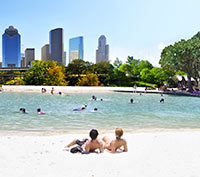 “I’ll bite. Here’s a very simple engineering analysis.
Problems with stream-fed swimming pools in Houston are going to be three-fold:
1) Silt (in engineer-speak, Total-Suspended-Solids or TSS). TSS is treated with sedimentation basins. That can be a large pool (that people don’t swim in) adjacent to the real pool. In water/wastewater treatment plants, a coagulant like alum is usually added to sedimentation basins to make TSS precipitate out quicker. If you’re going to do this with no chemicals, you’ve got to be willing to accept either VERY long treatment times, or only partially successful results. The tiny diameter of the clay particles that make up the TSS in our bayous just flat out won’t come out of suspension without a coagulant, so the water WILL be brown. It’s not necessarily a deal breaker — the water in Galveston’s brown too.
2) Bacteria (in engineer-speak, total coliform count). See here. Usually these are E. Coli, algae, and some protests. ALL streams/lakes/oceans in the entire world have this, even the cleanest and clearest. Realistically, to get an insurance policy to operate, the water’s going to have to be disinfected to some degree. That means chlorination (chemicals), ozonation (chemicals), or UV disinfection. More on UV in a minute.
3) Dissolved oxygen content. You don’t want the water to turn anaerobic. If there’s enough carbon-containing compounds dissolved in the water, the bacteria naturally in the water will eat it rapidly, causing the bacteria to use up all the oxygen that’s already dissolved in the water. This leads to any/all fish in the water suddenly dying off, as well as noxious smells and other really terrible stuff. You can make sure the dissolved oxygen doesn’t drop by filtering out carbon containing compounds (takes chemicals), or using aerators. A dual-way to solve the #2 and #3 issues is by passing the water over a very shallow (less than 6-in. deep) bed of rocks at a fast speed. Think rapids. This lets the water simultaneously re-oxygenate and also absorb huge amounts of UV. This might be the sort of silver bullet that makes this possible in Houston.
So: This is going to be expensive, but it’s probably do-able. However, the water is still going to be brown. Sorry.” [Ornlu, commenting on Bayou Swimming Hole Promoters Jump To Kickstarter To Jumpstart Project] Illustration: Houston Needs a Swimming Hole
“I’ll bite. Here’s a very simple engineering analysis.
Problems with stream-fed swimming pools in Houston are going to be three-fold:
1) Silt (in engineer-speak, Total-Suspended-Solids or TSS). TSS is treated with sedimentation basins. That can be a large pool (that people don’t swim in) adjacent to the real pool. In water/wastewater treatment plants, a coagulant like alum is usually added to sedimentation basins to make TSS precipitate out quicker. If you’re going to do this with no chemicals, you’ve got to be willing to accept either VERY long treatment times, or only partially successful results. The tiny diameter of the clay particles that make up the TSS in our bayous just flat out won’t come out of suspension without a coagulant, so the water WILL be brown. It’s not necessarily a deal breaker — the water in Galveston’s brown too.
2) Bacteria (in engineer-speak, total coliform count). See here. Usually these are E. Coli, algae, and some protests. ALL streams/lakes/oceans in the entire world have this, even the cleanest and clearest. Realistically, to get an insurance policy to operate, the water’s going to have to be disinfected to some degree. That means chlorination (chemicals), ozonation (chemicals), or UV disinfection. More on UV in a minute.
3) Dissolved oxygen content. You don’t want the water to turn anaerobic. If there’s enough carbon-containing compounds dissolved in the water, the bacteria naturally in the water will eat it rapidly, causing the bacteria to use up all the oxygen that’s already dissolved in the water. This leads to any/all fish in the water suddenly dying off, as well as noxious smells and other really terrible stuff. You can make sure the dissolved oxygen doesn’t drop by filtering out carbon containing compounds (takes chemicals), or using aerators. A dual-way to solve the #2 and #3 issues is by passing the water over a very shallow (less than 6-in. deep) bed of rocks at a fast speed. Think rapids. This lets the water simultaneously re-oxygenate and also absorb huge amounts of UV. This might be the sort of silver bullet that makes this possible in Houston.
So: This is going to be expensive, but it’s probably do-able. However, the water is still going to be brown. Sorry.” [Ornlu, commenting on Bayou Swimming Hole Promoters Jump To Kickstarter To Jumpstart Project] Illustration: Houston Needs a Swimming Hole

COMMENT OF THE DAY: FLOATING THE STUCK-ON STONE BELOW THE STUCCO 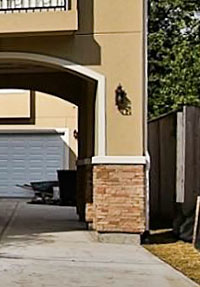 “Can just one builder find a way to transition a column [see photo detail at right] to the ground instead of the ridiculous ‘high-water’ pants look? It looks stupid and yet you see it everywhere. I assume for stucco construction it’s done to prevent water seeping/rot.” [Limestone, commenting on Wainscot World: Channeling the Paneling Within an Almost New Older Home in Mandell Place Seeking $1.35M] Photo: HAR

COMMENT OF THE DAY: ZONE D’ EROTICA IS A SYMBOL OF HOUSTON FREEDOM 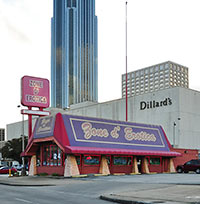 “I’ve always thought the Zone D’Erotica placement was one of the most charming things about Houston.
Welcome to Houston: you own it, you use it, however you want. Other cities would be finding a way to declare the parcel blighted at Simon’s behest, but in Houston that would be rightly considered outrageous.” [Spoonman, commenting on Construction Set To Begin on the Luxury Jewel Box, the Galleria’s Chi-Chi Pad Site] Photo: Candace Garcia
“I’ve always thought the Zone D’Erotica placement was one of the most charming things about Houston.
Welcome to Houston: you own it, you use it, however you want. Other cities would be finding a way to declare the parcel blighted at Simon’s behest, but in Houston that would be rightly considered outrageous.” [Spoonman, commenting on Construction Set To Begin on the Luxury Jewel Box, the Galleria’s Chi-Chi Pad Site] Photo: Candace Garcia

COMMENT OF THE DAY: HOW MT. YUPPIE WAS FORMED  “When this place opened, there was a ‘oh no, here come the yuppies‘ reaction. Now, years later, it is closing and people are complaining about how the Heights is losing its character. Basically, a reprise of ‘oh no, here come the yuppies.’ It is really just the process of yuppie sedimentary rock formation. Yuppies get older, have kids and become boring. Their hangouts go out of style and go out of business. Then, the next layer of yuppies comes in and opens new businesses and the prior layer of former yuppies groan about the neighborhood losing its character.” [Old School, commenting on Sunset Heights Wine Bar The Boom Boom Room Will Close Forever This Friday] Illustration: Lulu

COMMENT OF THE DAY: HOW TO GROW THE CITY MONEY ON TREES  “Hedge funds would blush at these returns. What did it cost the city to plant these suckers? $1k at most . . . And they got $50k apiece for them? Now I’m not saying we should celebrate the loss of these trees, but I hope right now some keen eager young city arborist is planning some oak plantings along the most outrage-worthy corridors in Houston, where they will best rankle the franchises of the future. How old does a tree have to be to elicit outrage? Maybe 20 years? At an eye-popping 22% IRR, perhaps some strategic tree-driven investments can make future union pension negotiations a bit easier . . .” [Sebastian Good, commenting on City Nets $300K Settlement for Late-Night Kirby Dr. Wendy’s Oak-Axing Incident] Illustration: Lulu

COMMENT OF THE DAY: HOW REAL ESTATE TRAILBLAZERS REALLY CAN BURN UP THE TRAIL  “There are very real consequences for having a NIMBY-smashing attitude for developers. Yes, the developers usually get their way, but they often end up ruining it for the next guy. Ashby developers will get to build, but the next guy might not because of the high-rise buffering ordinance that passed in the wake of the Ashby uproar. 380 agreements flowed like a river to Walmart and Kroger, but community uproar has meant that only Costco has since been able to get a similar deal despite some healthy opposition in city council. And there has only been one 380 agreement in 2014 outside of the downtown urban living initiative (which does require first floor space to be retail ready). There are a whole host of development regulations that have their root in NIMBY activism: drainage detention, tree ordinance, and parking minimums, to name a few.” [Old School, commenting on Comment of the Day: Don’t Let the Locals Get in the Way of Your Project] Illustration: Lulu

COMMENT OF THE DAY: DON’T LET THE LOCALS GET IN THE WAY OF YOUR PROJECT  “Good idea, let the Peasants with Pitchforks have an Illusion of Choice. Let them pretend to participate, let them vent some hot air, and then throw them a bone to the side so while they bark over that, you build what you were going to build in the first place. Don’t forget, they don’t have any legal standing in this matter, they’re merely a construction nuisance like graffiti or defecating raccoons, just to be handled as a normal course of business.” [commonsense, commenting on A New Sign of Future Development Appears on Heights Hike-and-Bike Trail Site] Illustration: Lulu

COMMENT OF THE DAY: HOUSTON’S REAL ESTATE BOOM IS OVER  “I’d like to see newer articles start noting that the jobs boom is already over and at this point it’s just the construction industry finishing off contractual commitments before we wrap it up and call the show over. past this it’s only retail & service sectors jobs growing which have a negligible impact on the overall economy anyhow due to the large supply of non-workers in the population and readily available labor. i’m not calling a downturn or anything here, but with drilling activity in the gulf starting to ease up (see hercules note [yesterday] morning about cutting personnel) and falling oil prices barring new onshore fields from starting up i’m not seeing any way for current growth trends to continue. fed pulling out of buying bonds will start hitting mortgage rates and drying up the cash closings that have helped stoked the fire as well so will be interesting to see if any slack appears in the market in the coming year.” [joel, commenting on AmREIT Takeover Approved; Bringing Gino’s East to Houston] Illustration: Lulu

COMMENT OF THE DAY: TURNING HOUSTON INSIDE OUT  “It might be that the best outcome for Houston is for the Inner Loop to have an exurban quality of life. Send commuter rail out to the suburbs — not for the suburbanites to commute to downtown — but for the Inner Loopers to commute outbound in the mornings to densely clustered (out of necessity) suburban tall office towers surrounding the stations, and then back into town in the evenings.
This is more viable than the traditional idea of New Urbanist suburbs with transit connecting them to a downtown core since politically none of Houston’s suburbs are on board with cultivating a small town ambience, but are ok with letting office builders do their thing.
To be sure, suburbanites would still commute to downtown but it will be seen as an aberration. Downtown will still have things to do after dark, but other areas of the Inner Loop, connected by LRT/buses/cars/bikes/sidewalks, will do a much better job of providing the QOL aspiring exurbanites may crave.
Suburbanites will, of course, still commute to a large extent to the office towers in their suburb. But they will do so by car, and won’t care about the urbanist quality of life (in other words, nothing will change for them).” [anon22, commenting on Here’s the Freshest Satellite Photo of Downtown Houston You’ll See All Day] Illustration: Lulu
“It might be that the best outcome for Houston is for the Inner Loop to have an exurban quality of life. Send commuter rail out to the suburbs — not for the suburbanites to commute to downtown — but for the Inner Loopers to commute outbound in the mornings to densely clustered (out of necessity) suburban tall office towers surrounding the stations, and then back into town in the evenings.
This is more viable than the traditional idea of New Urbanist suburbs with transit connecting them to a downtown core since politically none of Houston’s suburbs are on board with cultivating a small town ambience, but are ok with letting office builders do their thing.
To be sure, suburbanites would still commute to downtown but it will be seen as an aberration. Downtown will still have things to do after dark, but other areas of the Inner Loop, connected by LRT/buses/cars/bikes/sidewalks, will do a much better job of providing the QOL aspiring exurbanites may crave.
Suburbanites will, of course, still commute to a large extent to the office towers in their suburb. But they will do so by car, and won’t care about the urbanist quality of life (in other words, nothing will change for them).” [anon22, commenting on Here’s the Freshest Satellite Photo of Downtown Houston You’ll See All Day] Illustration: Lulu

COMMENT OF THE DAY: SCHOOL CHOICE  “. . . You have hit upon an issue that is at the core of not only the perception of school quality but also a prime driver of the residential real estate market, especially in the suburbs (and thereby a driver of retail and office markets as well). In my admittedly qualitative, non-scientific observation of the dialogue surrounding schools, the general public perception of school quality is not nearly driven as much by teaching methods, administrative / management styles, or teacher qualifications, as by the demographics of the students themselves. In the greater public’s mind, affluent demographics = good schools, with the demographics being the more independent variable (though there’s obviously a feedback loop as more affluent home buyers will be drawn to schools with already affluent students). Private schools are obviously not as related to real estate (with Strake Jesuit as an example), but the perception issue seems as relevant.
To put the issue another way, is a student from an affluent household likely to perform worse academically if he/she attends a school with less affluent demographics? My sense is, many people seem to think so and make school enrollment decisions accordingly. Perhaps this assertion is justified by empirical data and experience, I don’t know.” [Local Planner, commenting on How The Woodlands Has Gone Astray; A Suitable Houston Honor for the Inventor of Air Conditioning] Illustration: Lulu
“. . . You have hit upon an issue that is at the core of not only the perception of school quality but also a prime driver of the residential real estate market, especially in the suburbs (and thereby a driver of retail and office markets as well). In my admittedly qualitative, non-scientific observation of the dialogue surrounding schools, the general public perception of school quality is not nearly driven as much by teaching methods, administrative / management styles, or teacher qualifications, as by the demographics of the students themselves. In the greater public’s mind, affluent demographics = good schools, with the demographics being the more independent variable (though there’s obviously a feedback loop as more affluent home buyers will be drawn to schools with already affluent students). Private schools are obviously not as related to real estate (with Strake Jesuit as an example), but the perception issue seems as relevant.
To put the issue another way, is a student from an affluent household likely to perform worse academically if he/she attends a school with less affluent demographics? My sense is, many people seem to think so and make school enrollment decisions accordingly. Perhaps this assertion is justified by empirical data and experience, I don’t know.” [Local Planner, commenting on How The Woodlands Has Gone Astray; A Suitable Houston Honor for the Inventor of Air Conditioning] Illustration: Lulu

COMMENT OF THE DAY RUNNER-UP: ANOTHER REASON WHY WE GIVE THANKS ON THANKSGIVING  “If the Pilgrims had landed on the Island of Doom (Cabeza de Vaca’s name for Galveston) the Karankawas may well have simply eaten them. So the first Thanksgiving would consist of long pig festooned with buckle hats.” [Memebag, commenting on Houston’s Baby Boomer Housing Shortage; Cooking Up a Third Coast Thanksgiving] Illustration: Lulu


