CLOSING IN ON CLEANUP TIME AT THE SAN JACINTO WASTE PITS 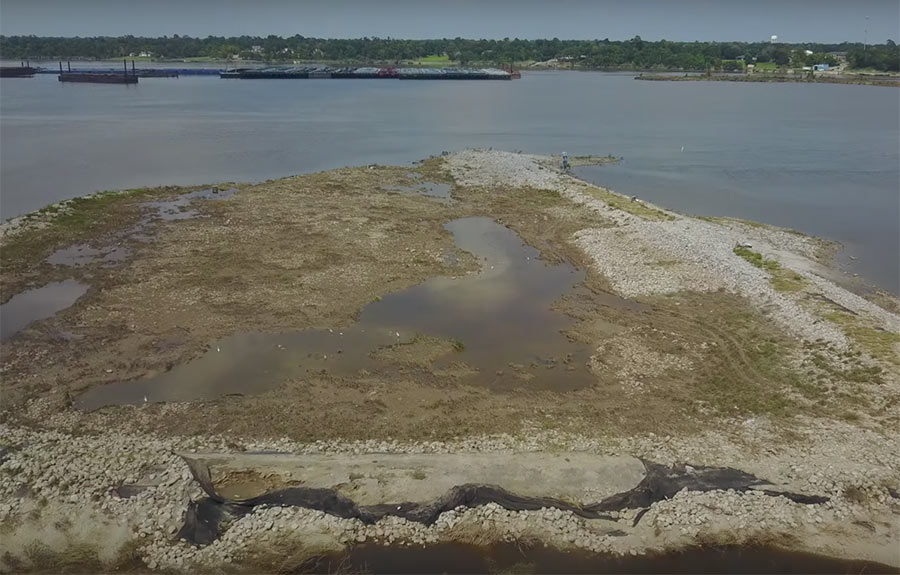 The EPA, TCEQ, and the 2 companies they’re holding responsible for cleaning up the San Jacinto Waste Pits near I-10 will soon get started on the design phase of a project to remove about 212,000 cubic yards of dioxin-contaminated muck from the Superfund site — reports the Chronicle’s Alex Stuckey. It’s “expected to take about 29 months,” she writes, “with the clean-up to follow.” The cooperation marks a friendly turnaround in the EPA’s relationship with the 2 companies — International Paper Co. and McGinnis Industrial Maintenance — which it thought about taking to court last year after they initially opposed the agency’s plan. Going that route, writes Stuckey, could have brought “years of litigation and cleanup delays.” [Houston Chronicle; previously on Swamplot] Photo of waste pits after Harvey flooding: Greg Moss

Sign up for the Newsletter


Tag: Environmental

COMMENT OF THE DAY: THE PITS  “Up until the 1930s, most oil taken from the ground was quite simply stored in earthen pits. Oil penetrated the soil to about 30 feet vertically and 100 feet horizontally. Humble by itself had 6,000,000 barrels of earthen pit storage. Note that the world’s largest documented land-based oilspills (not related to the Gulf War) were the Lakeview Gusher in Kern County, California (9 million bbl) and Fergana Valley in Uzbekistan (2 million bbl). Deepwater Horizon was the worst maritime spill (4.1-4.9 million bbl). These pits are not considered spills, but the land around them is far more impacted than a spill site. Back then, when pits failed from flooding or erosion, that was often unreported.” [TheNiche, commenting on An Update on the Leaky Oil Well in Missouri City] Image: Lulu

AN UPDATE ON THE LEAKY OIL WELL IN MISSOURI CITY 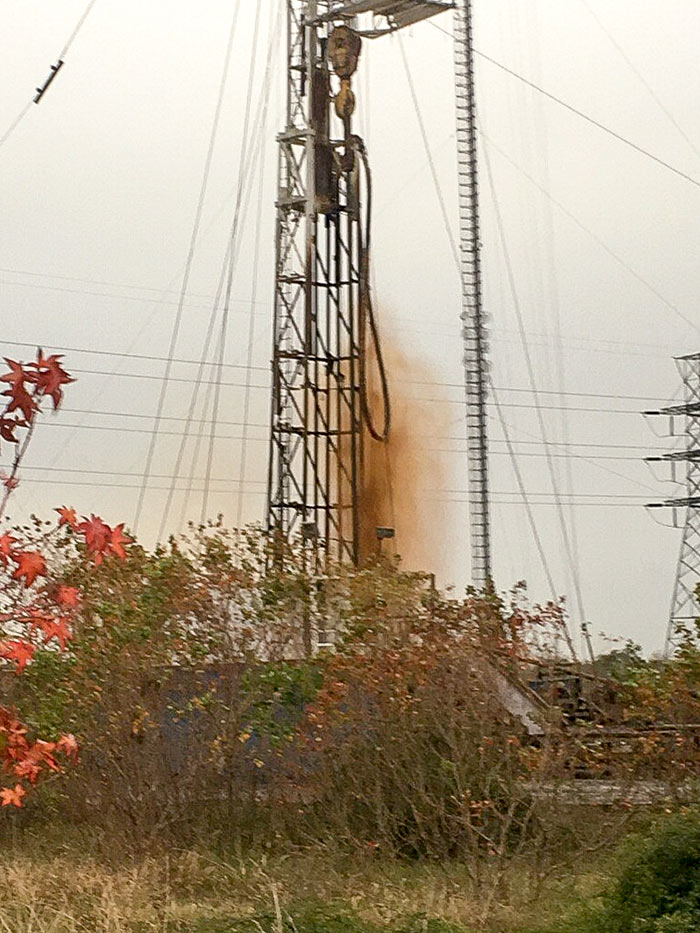 All liquids that spewed from the oil well on McHard Rd. just west of the Fort Bend Tollway after its blow-out accident last Wednesday have been removed from the ground surrounding the facility, the Missouri City Office of Emergency Management now reports. But that’s just the wet stuff. Workers from Haz Mat Special Services have so far dug up 1,200 of an expected 5,200–7,200 yards of possibly contaminated dirt from the immediate vicinity, to be replaced with soil from somewhere else. What else can they do? “Crews have also sprayed the area to reduce the odor. Air monitoring is still on going. Crews are also trying to prep the area for the predicted rain fall the region may receive.†[Missouri City Emergency Preparedness; previously on Swamplot] Photo: Fort Bend County OEM

IN THE MISSOURI CITY AIR Wild West Well Control is expected to finish capping an oil well this evening on McHard Rd. just west of the Fort Bend Tollway that blew out last night, sending foul-smelling fumes southeast into Fort Bend County. Nearby residents got a nose-ful: “Winds carried the smell across a large portion of the area; it is believed that the smell was from hydrogen sulfide. Total Fire has been conducting air monitoring in the area and has been unable to detect significant amounts of the chemical in the air.” [Fort Bend County OEM]
Photo: Fort Bend County OEM

COMMENT OF THE DAY: IS HOUSTON ALREADY EQUIPPED FOR EXTRATERRESTRIAL SPRAWL?  “What a waste! The coastal prairies will soon be gone and few will remember them. Everyone will say, ‘Well, Houston doesn’t have much in the way of natural environment anyway, but at least it has affordable housing compared to a lot of cities,’ and ‘Oh yeah, it is hot, but we stay inside most of the time, so who cares about the outside world?’ Maybe Houstonians should be the first to move to Mars or the Moon. (Hopefully) there aren’t any irreplaceable ecosystems to replace with big box stores, suburban homes, and highways!” [Duston, commenting on Houston Shifting to a Buyer’s Market; Making Way for the Lancaster Hotel Parking Lot] Illustration: Lulu


 From a top-floor perch in their tiny, handcrafted, award-winning live-work compound at 5910 Grace Ln. (featured a while back in Dwell magazine), architect Mark Schatz and designer Anne Eamon had front-row seats to the ongoing smelly, toxic, and deadly shitshow that marked the over-the-back-fence tenure of CES Environmental Services, in its facility at 4904 Griggs Rd., just a mile and a half south of the UH campus. Among the joys they were able to plug their noses and record was this tableau from July 2009: “In the first photograph [Schatz] took of the scene unfolding below him, shot like all the rest with the eye of an architect, perfectly framing the site, the tank farm is to the left, and a worker races from the right to the warehouse, which has a smoking hole blown through the roof. In a subsequent photo, oxygen tanks are wheeled in. Then the oxygen tanks fall over. Then a forklift shows up, and a crew starts setting the oxygen tanks upright. All this time, while they go through this Three Stooges routine, their co-worker is lying inside the warehouse covered in burns. You can see the back of a metal cylindrical tanker truck in the photos. [Schatz and Eamon] learn later that the fatally burned worker had opened the hatch on the tanker and switched on his flashlight to peer in. A spark from the flashlight set off a flash fire.”
Toxics by Design

GARBAGE PROGRAM STILL ‘ABSOLUTELY DOABLE,’ SAYS MAYOR PARKER 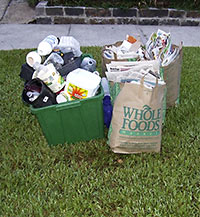 So Houston’s “One Bin for All” idea didn’t win the $5 million grand prize in Mayor Bloomberg’s philanthrophic challenge — but it did tie for second. And that means $1 million will be coming Houston’s way, along with $50,000 extra for being so darn lovable and winning the “fan favorite” vote online. And what’s the city going to do with all this dough? The Houston Chronicle’s Carol Christian reports that the consolation prizes might be just enough to get the program off the ground: Though the idea to combine garbage, recycling, and yard waste into one big bin for mechanized sorting later has been around for awhile, Mayor Parker says, “This award will allow us the seed money to begin the process . . . We have thoroughly researched the technology. It’s absolutely doable.” Construction on a new sorting facility could begin as early as 2014, reports Christian. [Houston Chronicle; previously on Swamplot] Photo of recycling bin in the Heights: Charles Kuffner

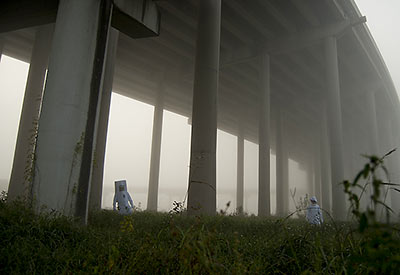
Invasion of the Art Snatchers: Carrie Schneider and Alex Tu, pictured above (though not in their everyday wear), are planning to reproduce the Art Guy Michael Galbreth’s “The Human Tour,” reports Houston Press‘s Meredith Deliso. As a UH student in 1987, Galbreth came up with the crosstown tour: a 40-mile, anatomically correct urban hike in the shape of a human figure.

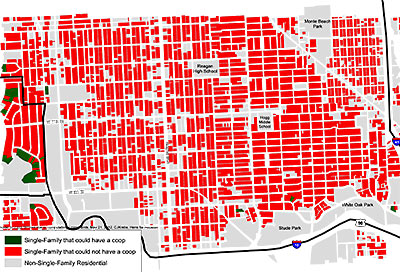
In Dallas, you have to keep at least 20 ft. between your chicken coop and your neighbor’s stuff. Here? It’s 100 ft. That’s why this map of the Greater Heights looks the way it does. Hens for Houston founder Claire Krebs, using GIS technology she learned as an engineering student at Rice, created a series of these maps (what she’s calling “policy-making tools”) out of HCAD data to show just how few Houstonians are allowed to keep hens — if they wanted, that is — because of a city ordinance requiring the 100-ft. setback.

UP IN THE PINES TO STOP THE KEYSTONE XL PIPELINE 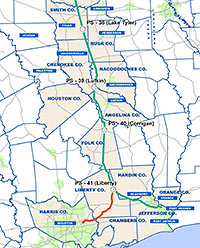 Three hours north of Houston in Cherokee County, reports Brantley Hargrove, protesters interfering with a 485-mile section of TransCanada pipeline being built to carry diluted bitumen south to refineries on the Gulf Coast faced some resistance of their own: “[An] 18-wheeler bearing a cherry picker to pluck protesters out of trees slowed as it approached a shouting, sign-wielding crowd. Several young men leaped in its path. One fell beneath the truck. The others screamed and pounded the hood with their fists. A deputy rounded the front of the truck and drove the protesters back, loosing clouds of pepper spray. [A 75-year-old woman], standing off to the side of the road, caught a gust of the burning mist.” Separately, TransCanada’s website notes its plans for the Houston Lateral Project (shown in red on the map), a 47-mile spur that will come close to Beltway 8. [Houston Press; Gulf Coast Project] Map: TransCanada

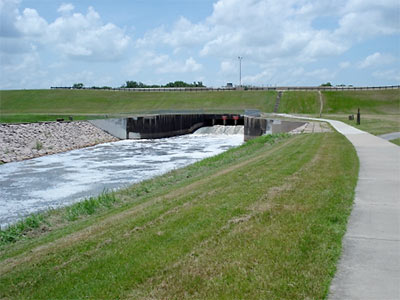
In what appears to be a last-ditch effort to block construction of Segment E, the straight-throught-the-Katy-Prairie section of the Grand Parkway scheduled to begin construction this month, the Sierra Club has filed a new suit against the Army Corps of Engineers, the DOT, the FHA, the Texas Transportation Commission, and several public officials. But the lawsuit also focuses attention on the health of the Addicks and Barker Dams on Buffalo Bayou, which control waterflow through west and Downtown Houston. According to a July 2010 document unearthed by the environmental group this past March through an information request, the Army Corps has rated the status of both dams as “urgent and compelling” since September 2009; that rating indicates the Corps considers them to be 2 of the 6 most dangerous dams in North America.

COMMENT OF THE DAY: THIS LAND IS THEIR LAND “Heard about it. Shouldn’t matter who the purchaser is, in fact, after reading your comments, it is probably more fair all around if they do not disclose who they are. Posters on this site are quite amazing. I am astonished daily in what they seem to feel they are entitled to when it comes to property owned by others. And how much Swamplot originators do to creatively stir the pot.” [LudiKris, commenting on How Does a Public Notice About ExxonMobil’s Giant New Corporate Campus Stay Under the Radar?]
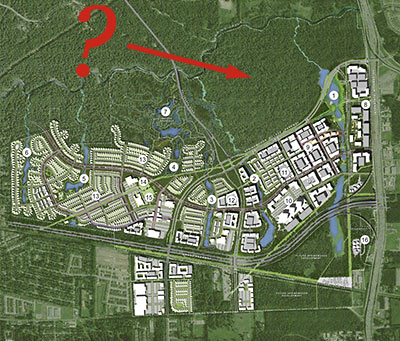
A show of hands, please: How many of you knew about the public notice posted by the Army Corps of Engineers this January asking for comments on environmental issues related to the new 389-acre office campus that ExxonMobil plans to build for its employees north of Houston, just south of Spring Creek? If you heard about the permit application before the February 17th commenting deadline, please let us know — just add a comment to this story.
Why is Swamplot asking?

DOWNTOWN’S PIGEON POOP POWDER KEG WILL NOT GO BOOM Swamplot reader ms. rosa reports on tonight’s scheduled demolition of the 1906 Savoy Apartments building (later the Savoy-Field Hotel) at Main St. and Pease Downtown: “Just spoke with Cherry [Demolition]. They will start tearing down the building tonight (Friday, October 2, 2009) at 7:00pm. It will not be imploded (as hoped!)” [Swamplot; previously]
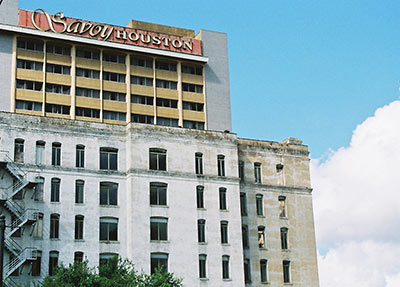
City officials have decided to give the owner of the original 1906 Savoy Apartments building on Main St. Downtown an extra week to knock down the structure before going ahead with their own emergency demolition plan. The building’s owner — listed in Harris County records as Michael Nassif — will now have until midnight next Friday, October 2nd, to have a contractor of his own choice begin dismantling the structure. If that doesn’t happen, the city-selected contractor will complete the demo that weekend — and leave the property with a lien for the $448,600 cost.
While negotiations have focused on how quickly work can begin, residents of the Beaconsfield across Pease St. may be more interested in how long the demo will take — and how it will be done. Architect David Hall, who has studied the building for several developers, spoke to abc13 reporter Gene Apodaca about the asbestos embedded in the building’s crumbling interior plaster:
“It’s full of environmental issues. There are pathogens that are a result of the pigeon droppings, there are areas of the building I measured where pigeon droppings were six inches thick,” said Hall.


