

A couple of simulated fly-overs of a portion of a revamped Allen Pkwy., put together by consulting engineering firm Walter P Moore, show how the signature River Oaks-to-Downtown sorta-highway will look after a park-centered makeover is completed next summer. The projected $10 million redo partially answers the question popping up in many people’s minds after seeing all the new trails and structures and amenities and dogs going in along the bayou it lines: How are car-bound Houstonians supposed to get to the new Buffalo Bayou Park?
Part of the answer, of course, is by using 175 new angled parking spaces, most of them lining a new separate parking access lane lining the north side of Allen Pkwy. between Rochow St. and Eleanor Tinsley Park. As the video above (showing the journey eastbound from Montrose Blvd. to Park Vista Dr.) indicates, if you’re headed into Downtown, you’ll need to turn around and head in the opposite direction somewhere to park in one of them. Here’s a video view of the journey westward from Park Vista (across from Eleanor Tinsley Park) back to Montrose Blvd., along which the spots are angled for easy entry:

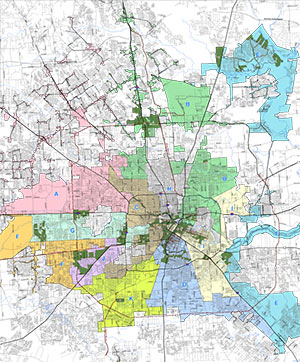 A reader has a question about a particular Tax Increment Reinvestment Zone in Houston: “In this example scenario, the city of Houston is giving [Hurricane Ike] money to a developer for infrastructure improvements on their lot (located in a TIRZ) but the requirement is that the developer must build some affordable homes on that lot.
The twist to this is that the city would give the developer money, but only if it is given through the TIRZ. Speaking with the TIRZ board, they said that they plan to distribute that money around the entire TIRZ and not just to that single development. This of course has the neighboring residents and the developer worried about how the funds will be given.
Is this the normal process for distributing Ike funding? And can a TIRZ take money away from the developing area?” Map of area Tax Increment Reinvestment Zones:
A reader has a question about a particular Tax Increment Reinvestment Zone in Houston: “In this example scenario, the city of Houston is giving [Hurricane Ike] money to a developer for infrastructure improvements on their lot (located in a TIRZ) but the requirement is that the developer must build some affordable homes on that lot.
The twist to this is that the city would give the developer money, but only if it is given through the TIRZ. Speaking with the TIRZ board, they said that they plan to distribute that money around the entire TIRZ and not just to that single development. This of course has the neighboring residents and the developer worried about how the funds will be given.
Is this the normal process for distributing Ike funding? And can a TIRZ take money away from the developing area?” Map of area Tax Increment Reinvestment Zones: 
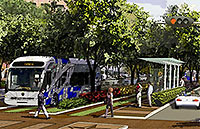 Why not both? Yesterday, Mayor Parker announced a $556 million plan that, if approved by city council on April 24, wouldÂ
Why not both? Yesterday, Mayor Parker announced a $556 million plan that, if approved by city council on April 24, would 
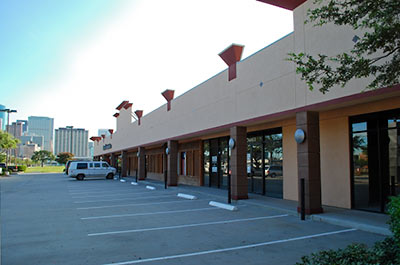



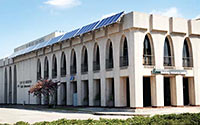 City council today approved the sale of Houston’s code enforcement building at 3300 Main St. to the Midtown Redevelopment Authority, for $5 million. The 57,899 sq.-ft. structure and parking garage on a full Midtown block, which also houses the city’s Green Building Resource Center, received several sealed private-sector bids before the February 17th due date. Last week, Mayor Parker declared that the Midtown TIRZ had submitted the high bid, but 2 council members disputed that, claiming the group hadn’t submitted a bid for the property at all. (One of them, Anne Clutterbuck, was the lone dissenter in today’s vote.) Chronicle reporter Chris Moran hasn’t been able to get a straight answer yet, but interprets a staff report to mean that the TIRZ did not submit a formal bid — the city simply determined a purchase from the government entity would be “the most advantageous.” What’s all the fuss? “The city built the sale of 3300 Main into its FY 11 budget, and it is now depending on that sale to help it bridge a $21 million projected budget shortfall for the fiscal year that ends June 30.
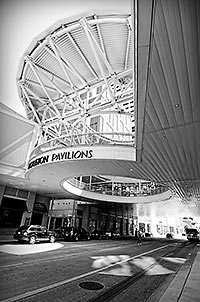 The Downtown Redevelopment Authority this week approved a loan of $3.3 million to the developers of the Houston Pavilions. But the mall’s developers likely won’t need to pay it back. According to a 2006 agreement that included a promised $14.3 million of TIRZ reimbursements and grants for the sleepy downtown redevelopment project, the developers would only receive the last $3.3 million payment once the retail portion of the project was 70 percent leased. At the moment — thanks in part to efforts by management earlier this year to prevent Books-A-Million from closing up shop there — the retail spaces are 62 percent full. Not a problem: The interest-only loan will tide the developers over until they can get their numbers up.